There was a time when I thought broken relationships were mostly caused by the obvious heartbreaks..
The affairs.
The lies.
The abandonment.
The harsh words that could never be taken back.
But the longer I live, the more I realize that many relationships do not fall apart because of one catastrophic event. They unravel through a thousand smaller choices that seem insignificant in the moment.
A husband stops listening.
A wife stops sharing what is really on her heart.
A friend becomes increasingly self-centered.
A family member chooses pride over reconciliation.
Someone begins treating people as disposable instead of valuable.
Little by little, something changes.
Not only in the relationship itself, but in the person.
Because every choice we make is shaping us into someone.
The way we think eventually affects the way we live.
The way we live eventually affects the way we treat others.
And the way we treat others reveals what is happening within our hearts.
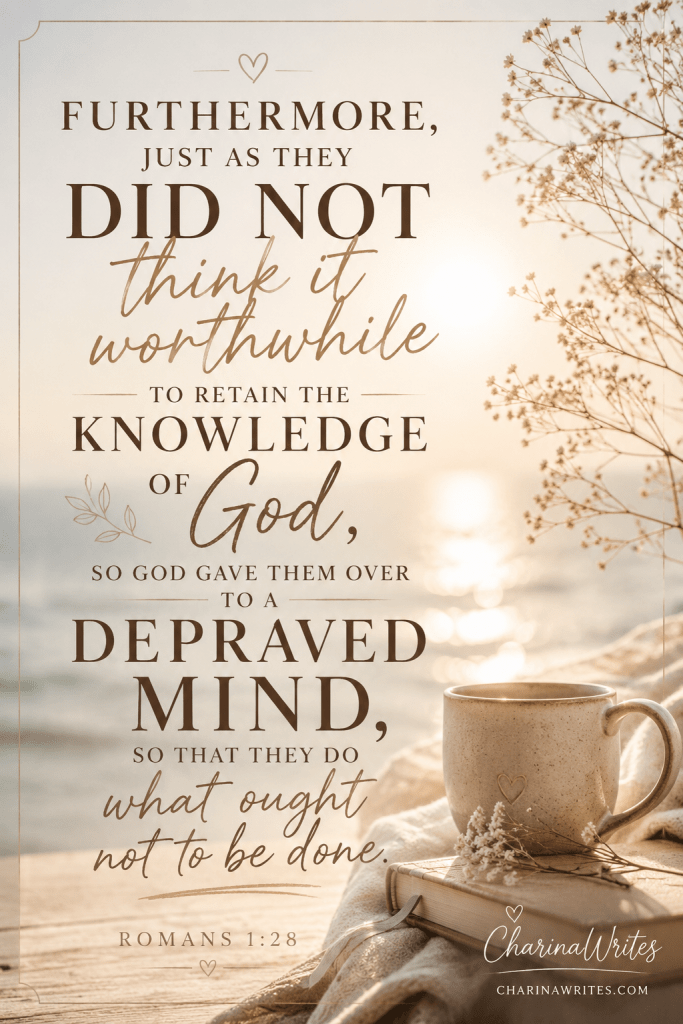
This is why Romans 1:28 feels just as relevant today as it was when it was first written.
“Furthermore, just as they did not think it worthwhile to retain the knowledge of God, so God gave them over to a depraved mind, so that they do what ought not to be done.”
At first reading, the verse can sound distant and severe. It is tempting to read it as a description of society’s problems, of moral decline, of people who have wandered far from God.
But perhaps it is also an invitation to examine ourselves.
Because the verse begins with something surprisingly simple.
They did not think it worthwhile to retain the knowledge of God.
Before the actions came the attitude.
Before the behavior came the belief.
Before people began doing what ought not to be done, they first decided that God was no longer important enough to remain at the center of their thinking.
That is where so many struggles begin.
Not necessarily with open rebellion, but with gradual neglect.
We stop seeking God’s wisdom and start relying entirely on our own understanding.
We stop asking what is right and begin asking only what is convenient.
We stop pursuing truth and begin pursuing whatever feels good, validates us, or serves our interests.
And when God is removed from the center, something else inevitably takes His place.
Usually ourselves.
This is not merely a spiritual issue. It becomes a relational issue as well.
When people lose sight of God, they often lose sight of the value of other people.
Relationships become more transactional.
Commitment becomes conditional.
Love becomes dependent on personal benefit.
Forgiveness becomes harder.
Humility becomes rarer.
People are no longer seen as souls to cherish but as obstacles, conveniences, or sources of validation.
We see this everywhere.
We see it in marriages where one spouse slowly neglects the emotional needs of the other while expecting loyalty and affection in return.
We see it in friendships that last only as long as they remain beneficial.
We see it in families where pride prevents reconciliation.
We see it in workplaces where ambition matters more than integrity.
We see it online where cruelty is often rewarded and compassion is mocked.
The symptoms may look different, but the root is often the same.
A heart that has drifted away from God will eventually drift away from His ways.
And God’s ways have always been deeply relational.
He calls us to love one another.
To bear with one another.
To forgive one another.
To honor one another.
To encourage one another.
When those values disappear, relationships suffer.
People suffer.
Entire communities suffer.
Yet Romans 1:28 is not only a warning. It is also a reminder.
It reminds us that what we allow to shape our minds matters.
Every day we are being influenced by something.
Our culture.
Our desires.
Our wounds.
Our fears.
Or God’s truth.
The question is not whether something is shaping us. The question is what.
Because what fills our minds eventually finds its way into our words, our actions, and our relationships.
Perhaps that is why protecting our relationship with God is not merely about personal spirituality. It is about becoming the kind of person who loves others well.
The kind of husband or wife who remains faithful.
The kind of friend who can be trusted.
The kind of parent who leads with wisdom.
The kind of person whose presence brings peace rather than pain.
When we retain the knowledge of God, we do not become perfect.
But we remain anchored to the One who continually teaches us how to live and how to love.
And in a world where relationships are often strained, fractured, and easily discarded, that may be more important now than ever.
And perhaps that is the quiet lesson of Romans 1:28: what we choose to retain in our hearts will eventually shape the direction of our lives and the kind of person we become.
Until next time,


